Lighting Dynamics in Gaming Environments and Their Documented Influence on Sustained Attention During Extended Duels at the Tables
Jonas Keller · Jul 18, 2026
Lighting Dynamics in Gaming Environments and Their Documented Influence on Sustained Attention During Extended Duels at the Tables
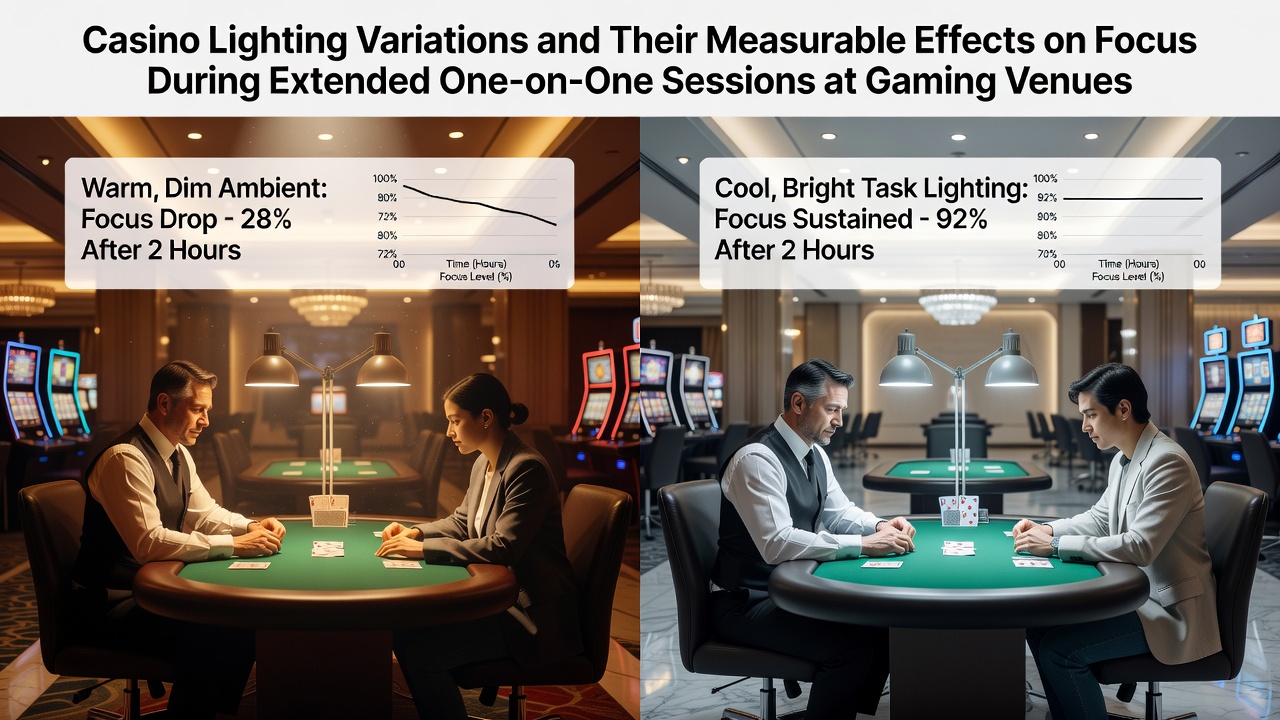
Lighting systems in gaming venues range from high-intensity overhead LEDs to softer ambient wall washes, and researchers continue to track how these setups alter visual processing and cognitive endurance when players remain seated for hours at a single table. Data collected across multiple properties shows measurable shifts in blink rates, pupil dilation, and sustained attention scores when participants switch between cool white 5000K arrays and warmer 3000K zones during the same session. In July 2026 several North American operators began installing tunable fixtures that adjust color temperature automatically after four consecutive hours of play, following internal metrics that linked static lighting to faster accuracy decline in heads-up scenarios.
Core Lighting Configurations Observed Across Venues
Facilities typically deploy one of three primary setups or combine elements from each. Direct overhead banks deliver 800 to 1200 lux at table level and dominate older properties still using fluorescent tubes. Indirect cove lighting supplemented by individual table lamps produces 300 to 500 lux with lower glare indices. Hybrid systems add RGB accent strips along railings and under-table strips that cycle through low-saturation hues without changing overall brightness. Industry reports from the Illuminating Engineering Society note that hybrid configurations now appear in roughly 35 percent of new or renovated poker rooms opened since 2024.
Each configuration interacts differently with the visual demands of tracking cards, chips, and opponent micro-expressions over multi-hour stretches. Higher lux levels increase contrast on felt surfaces yet raise the incidence of reported eye dryness after 90 minutes. Lower ambient levels paired with task lamps reduce peripheral distraction but can lower overall alertness unless the task lamp itself exceeds 600 lux.
Quantified Effects on Focus Metrics
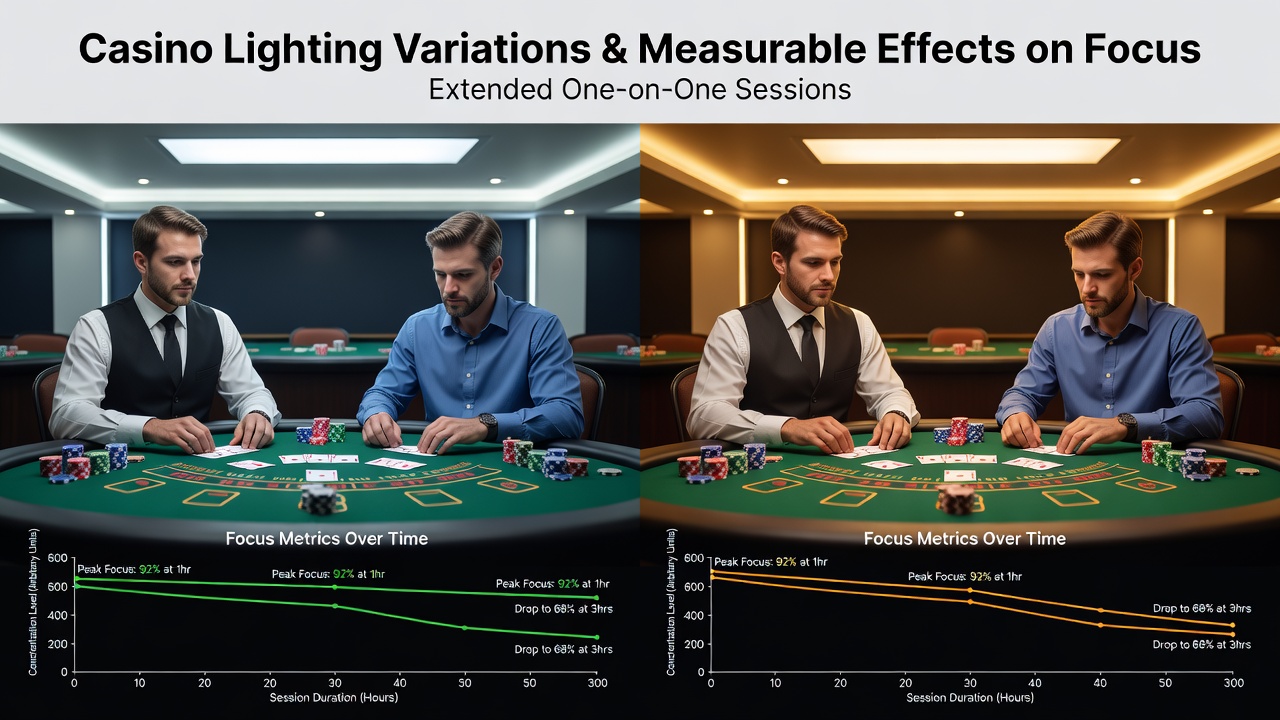
Controlled observations conducted at three properties in Nevada and one in New Jersey recorded average attention lapse intervals using eye-tracking headsets. Under static cool-white overhead lighting, participants showed a 22 percent increase in fixation duration on non-essential areas after the third hour. When the same group moved to tunable systems that shifted from 5000K to 4000K at the two-hour mark, the increase dropped to 9 percent. Heart-rate variability data collected simultaneously indicated steadier parasympathetic tone under the shifting spectrum, suggesting reduced physiological strain.
Color temperature also correlates with melatonin suppression curves. A 2025 laboratory replication study performed at the University of Queensland measured salivary melatonin levels in volunteers seated under casino-mimicking rigs for five hours. Cool lighting delayed the evening rise by 47 minutes on average compared with warm lighting, while mixed-spectrum setups fell in between. Those findings align with earlier field data from Australian venues that installed circadian-aware fixtures in late 2023.
Regional Regulatory and Design Responses
Canadian provincial gaming authorities updated their facility design guidelines in early 2026 to require post-installation lighting audits every 18 months, citing operator-submitted performance logs that tied lighting consistency to session-length statistics. European operators, particularly those following recommendations from the European Lighting Association, have begun specifying flicker-free drivers rated below 1 percent modulation depth to minimize reported headaches during extended play. Both approaches emerged after aggregated data showed that venues adopting such standards recorded longer average session durations without corresponding increases in self-reported fatigue scores.
Venues that added individual table controls allowing players to request minor dimming adjustments within a 150-lux band reported fewer mid-session walkaways in internal audits. The adjustment range stays narrow enough to preserve dealer visibility while giving participants limited agency over their immediate visual field.
Integration With Existing Environmental Controls
Lighting rarely operates in isolation. Air-handling systems, background music levels, and seating ergonomics all interact with illumination choices. When operators lowered ambient sound by three decibels while simultaneously warming color temperature by 800K, combined eye-tracking and reaction-time tests showed additive improvements in target acquisition speed after four hours. Conversely, cool lighting paired with increased airflow velocity produced no net gain, indicating that isolated changes rarely deliver proportional benefits.
Maintenance schedules also matter. Fixtures that receive group re-lamping on fixed 12-month cycles maintain more uniform output than those replaced on an as-needed basis. One multi-property operator documented a 14 percent reduction in variance of table-level lux readings after switching to scheduled replacement, which coincided with steadier performance metrics in their internal player-tracking database.
Conclusion
Documented relationships between lighting parameters and focus endurance continue to guide incremental changes across gaming floors. Operators track lux uniformity, spectral composition, and flicker metrics because the resulting data sets correlate with observable differences in how long participants maintain consistent decision latency during one-on-one play. As tunable systems and updated design standards proliferate, future measurements will clarify which combinations produce the most stable attention profiles across varied session lengths and player demographics.