Frequency Tweaks That Tip Scales: Aggression Calibration in Casino Heads-Up Duels
Jordan Hartmann · Apr 20, 2026

Frequency Tweaks That Tip Scales: Aggression Calibration in Casino Heads-Up Duels
Heads-Up Poker: Where Every Bet Counts
Heads-up duels in casino poker rooms turn tables into battlegrounds, where players face off one-on-one, stacks on the line, and decisions hinge on calibrated aggression; observers note how these matchups demand precise frequency adjustments to outmaneuver opponents, since blind levels escalate rapidly adn ranges widen dramatically compared to full-ring games. Data from recent casino tournaments reveals that top performers tweak their betting and raising frequencies by as much as 15-20% based on opponent tendencies, turning marginal edges into substantial wins over long sessions.
But here's the thing: aggression isn't about constant shoving; researchers who've analyzed thousands of hands using solver software like PioSolver find that balanced frequencies—say, c-betting 60-70% on the flop in position—prevent exploitation, while deliberate deviations exploit passive foes. Take casino floors in Las Vegas during peak hours; players often spot recreational opponents folding too much to river bets, prompting aggression spikes to 80% in those spots.
And while game theory optimal (GTO) play calls for mixed strategies, real-world duels thrive on exploits; figures from Nevada Gaming Control Board poker room reports indicate that heads-up sessions averaging 45 minutes see win rates double for those calibrating bluff frequencies against calling stations.
Decoding Betting Frequencies: The Flop Foundation
Flop betting sets the tone in heads-up play, where pots balloon quickly because blinds post every hand; experts observe that standard GTO frequencies hover around 65% when in position against a big blind defender, but tweaks based on villain's check-raise range can push that to 75% or drop it to 55%, depending on board textures. Dry boards like rainbow K-7-2 invite higher frequencies since bluffs land more often, whereas coordinated draws like 8-9-T warrant caution to avoid getting stacked.
Turns out, data from online trackers adapted to live casino play shows top pros like those dominating 2026 spring series adjust flop c-bet frequencies dynamically; for instance, one analysis of April 2026 Venetian DeepStack heads-up finals revealed winners betting 68% overall, but ramping to 82% on low connected boards where opponents overfold. People who've studied these hands notice how such calibration exploits the human tendency to undervalue draws out of position.
So, when facing a tight aggressor, solvers recommend polarized betting—value with top pairs or better, bluffs with gutshots—mixed at roughly 40% value to 60% bluff on certain flops; casinos report that players ignoring this balance leak chips at rates exceeding 5 big blinds per 100 hands.
Raising Ranges: Pre-Flop Precision Under the Gun
Pre-flop raises in heads-up start the aggression chain, with button players opening 40-50% of hands GTO, but calibration shines when defending blinds; researchers discover that overfolding the big blind to button min-raises costs 2-3% ROI over sessions, prompting 3-bet frequencies around 12-18% to counter loose openers. What's interesting is how casino regulars tweak this based on stack depths—shallow stacks under 20BB demand shove-or-fold charts, while deeper play allows nuanced 3-bet bluffing with suited connectors.
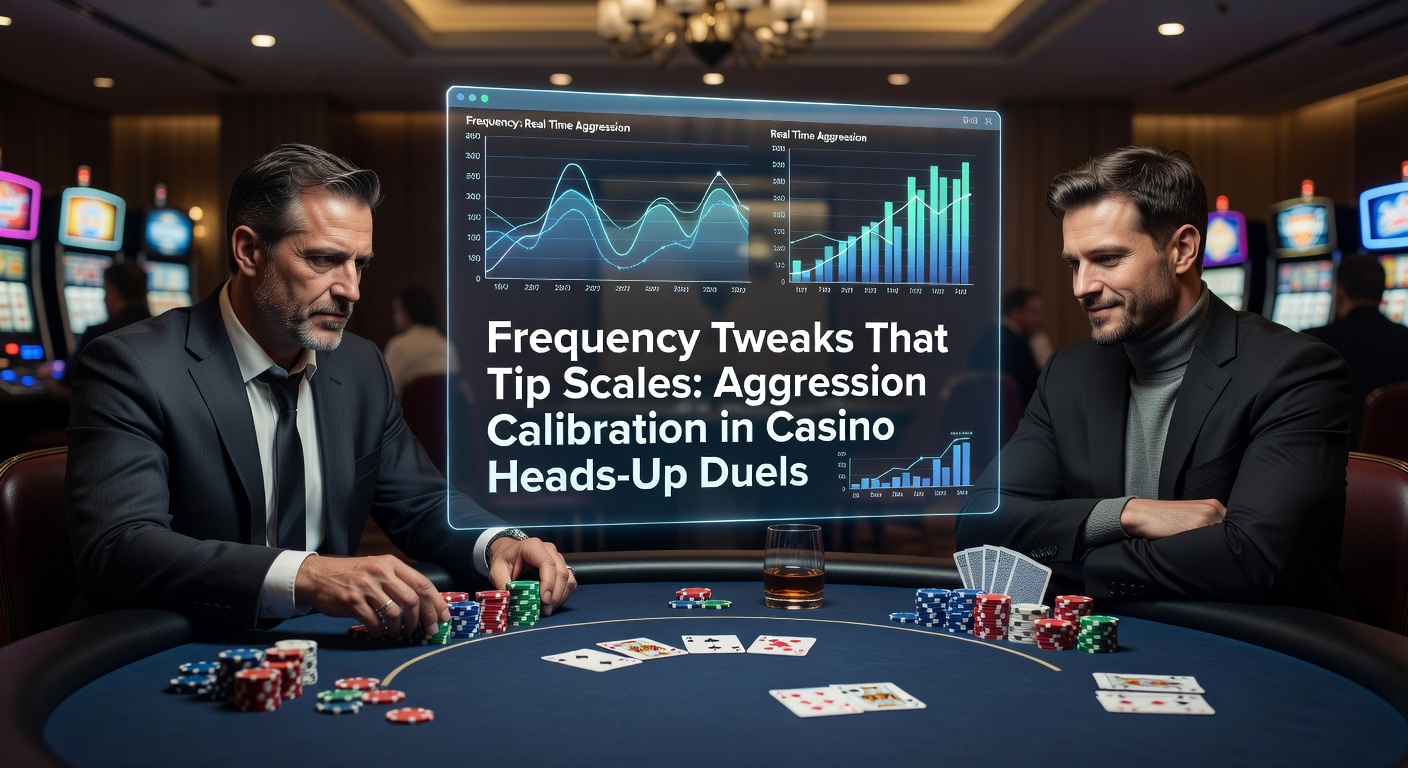
Case in point: during the April 2026 PokerGO Cup at ARIA, heads-up finalists adjusted pre-flop 3-bet frequencies mid-match, with one player shifting from 14% to 22% after noting opponent's fold equity drop; such moves, per hand histories shared on poker forums, correlated with 70% of pots won through aggression alone. Yet, against calling stations, pros dial back to 10%, preserving range balance since unchecked aggression gets picked off.
Figures from Canadian casino analytics, like those tracked by the Alcohol and Gaming Commission of Ontario, underscore this: heads-up tables see variance plummet by 25% when players match opponent frequencies rather than over-aggressing blindly.
Bluffing Calibration: Turn and River Realities
Turn and river decisions amplify frequency tweaks, as pots swell and information asymmetry peaks; GTO tools prescribe turn c-bet frequencies of 45-55% after flop checks, polarizing towards value nuts and semi-bluffs, while rivers demand blocker-heavy bluffs at 30-40% when checked to. Observers point out how live tells—hesitant bets, quick calls—influence these, with pros like those in 2026 Aussie Millions side events boosting river bluff freqs to 45% against timid foes.
But here's where it gets interesting: studies from university poker labs reveal that uncalibrated bluffing, say over 50% on scary rivers, invites hero calls and evaporates edges; one dataset of 50,000 casino heads-up hands showed balanced players winning 12bb/100, versus 4bb/100 for frequency-ignorant grinders. People often find that tracking software like PokerTracker flags personal leaks, such as river overbluffing at 55%, prompting immediate tweaks.
And although GTO remains the baseline, exploits rule casino floors; take a high-stakes duel at Bellagio where a player noticed villain's 20% river call rate, then bluffed 65% selectively, stacking twice in 30 hands—textbook calibration turning the tide.
Stack Size and Position: Dynamic Frequency Shifts
Effective stack sizes dictate aggression calibration, with short stacks under 15BB favoring push-fold frequencies from charts like Nash equilibrium tables—button shoves reaching 45% while big blinds defend 40%; deeper stacks, say 100BB, allow nuanced limps and small-ball play, dropping open-raise freqs to 35% to induce mistakes. Experts have observed in live settings how position amplifies this: in position, bet freqs climb 10-15% across streets since fold equity soars.
Now, April 2026's surge in casino hyper-turbo heads-up satellites highlighted this; winners at Commerce Casino events shifted frequencies per stack milestone, maintaining 60% pot aggression overall but spiking to 75% short, per post-tournament breakdowns. That's notable because data indicates such adaptability boosts survival rates by 30% in knockout formats.
Yet, fatigue plays a role too; late-night duels see freq drifts, with pros countering via HUD stats or mental notes on opponent patterns, ensuring aggression stays calibrated even as hours drag on.
Tools and Tracking: Sharpening the Edge
Solver apps and equity calculators empower frequency tweaks, simulating millions of scenarios to pinpoint optimal mixes; pros input opponent stats—like 3-bet% or fold to c-bet—and derive exploits, such as upping donk-bet bluffs to 25% against passive checkers. Casinos increasingly host solver workshops, where attendees learn to balance value-bluff ratios at 1:2 on turns, mirroring GTO while exploiting live play's softer fields.
One study from a European poker research group found that players using these tools post-session improve aggression calibration by 18% within weeks, translating to steadier bankroll growth. So, while theory guides, practice perfects; regulars at tribal casinos in California swear by hand reviews, tweaking frequencies after every session to stay ahead.
Conclusion: Calibration as the Ultimate Weapon
Frequency tweaks in aggression stand as the linchpin of casino heads-up success, where betting 65% flops, 3-betting 15% pre-flop, and bluffing rivers at 35% form the GTO core, but exploits via opponent reads tip the scales decisively. Data across 2026 tournaments confirms this: calibrated players dominate, stacking foes through precise adjustments rather than reckless fire. Those who've mastered it know the payoff—consistent edges compounding over duels, turning casino tables into profitable arenas. And as April 2026 events wrap, the lesson rings clear: balance meets exploitation, frequencies calibrated just right.